On this page
SOHC and DOHC describe how an engine's camshafts are arranged in the cylinder head. Both designs operate the intake and exhaust valves, but they differ in the number and placement of camshafts and in how those camshafts act on the valves. The choice affects packaging, valve-train complexity, and the performance an engine can support; neither layout is automatically better in every application.
What SOHC and DOHC mean
SOHC means single overhead camshaft. One camshaft in each cylinder head operates both the intake and exhaust valves. DOHC means dual overhead camshaft: two camshafts in each cylinder head, typically with one operating the intake valves and the other operating the exhaust valves. On a multi-bank engine, each bank has its own cylinder head and camshaft arrangement.
The camshaft rotates in time with the crankshaft. Its shaped lobes determine when and how far valves open. Valve springs return the valves toward their seats as the lobes rotate away. The exact drive and valve-actuation parts depend on the engine design.
How an SOHC valvetrain works
An SOHC cylinder head commonly includes intake and exhaust valves, a camshaft, and rocker arms. As a cam lobe rotates, it moves a rocker arm, which in turn opens a valve. The valve spring closes the valve as the lobe moves past. Some SOHC designs use different followers or arrangements, so this is a representative layout rather than a rule for every engine.
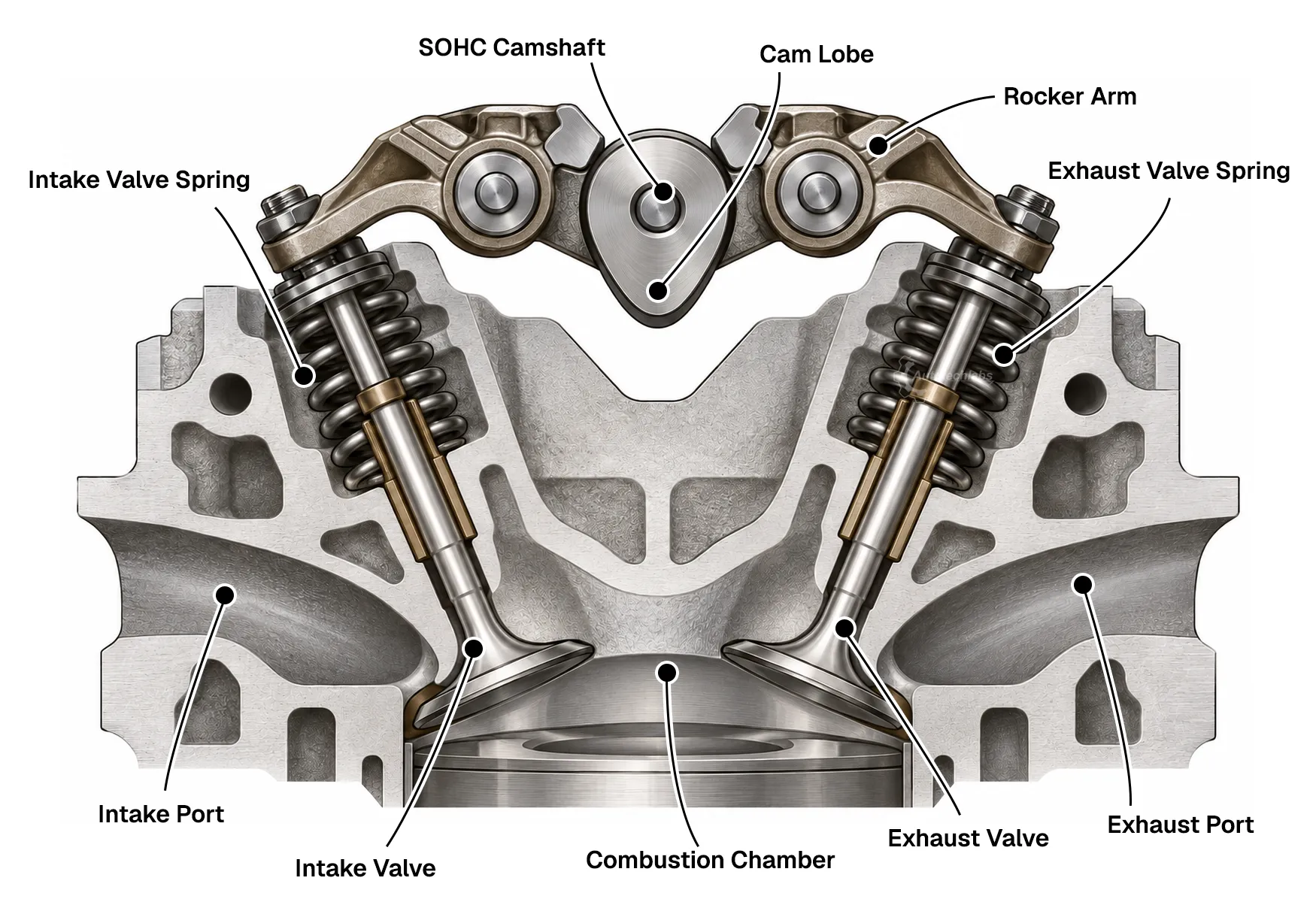
- SOHC Cylinder-Head Layout -
With fewer camshafts and associated parts, an SOHC layout can be simpler and less costly to manufacture. It can also have a compact, relatively light valvetrain. Many SOHC engines use two or three valves per cylinder, but four-valve SOHC designs also exist. The number of valves depends on the engine's geometry and actuation design, not only on the camshaft count.
How a DOHC valvetrain works
A DOHC cylinder head has separate camshafts for the intake and exhaust valves. The cam lobes usually act through followers or tappets positioned over the valves, though the specific hardware varies. Separating the camshafts gives designers more freedom to position and time the intake and exhaust valves independently.
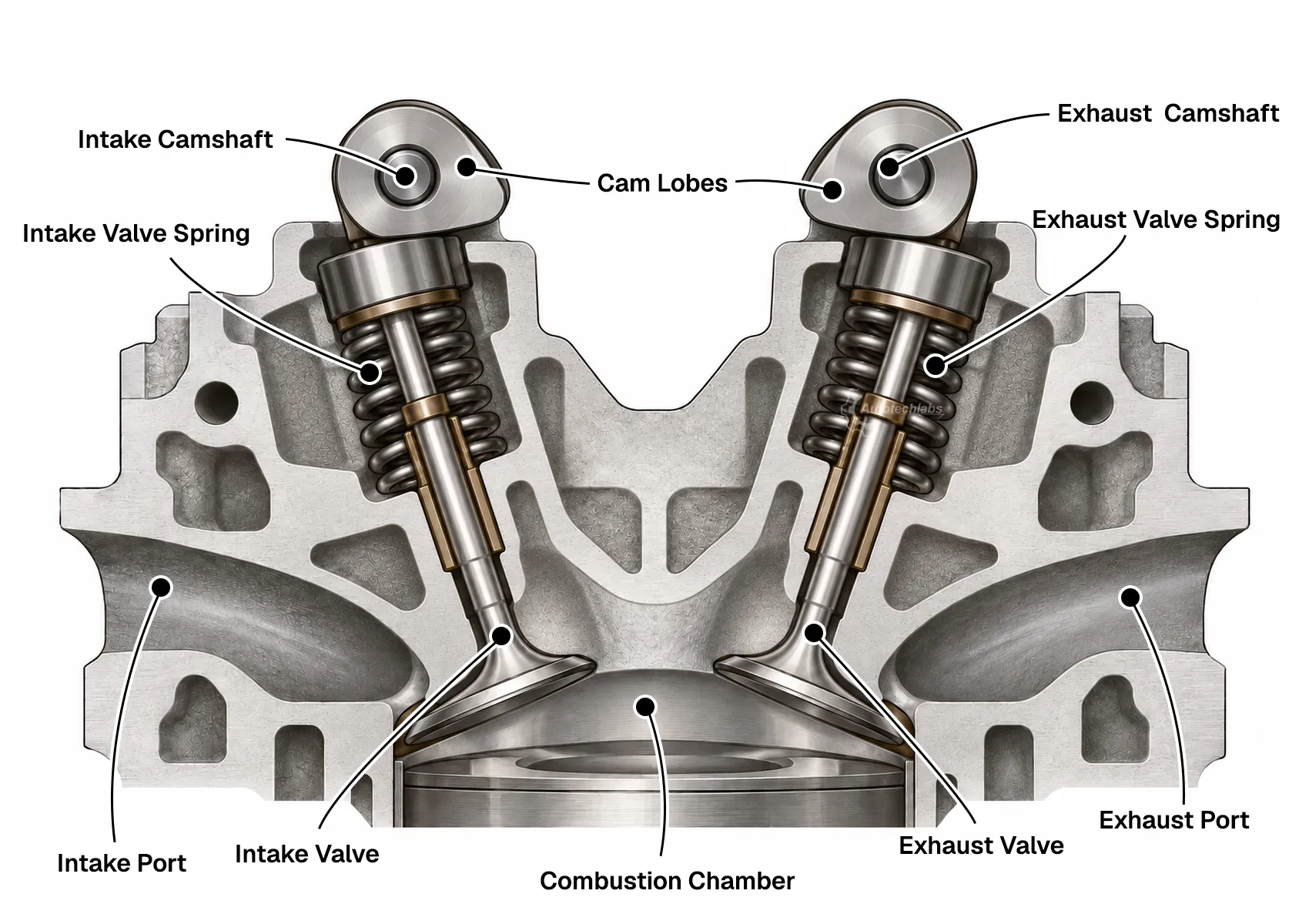
- DOHC Cylinder-Head Layout -
DOHC engines commonly use four valves per cylinder: two intake valves and two exhaust valves. More valve area can help the engine move air into and out of the cylinder, especially at higher engine speeds. The layout can support strong high-rpm breathing and technologies such as variable valve timing, but DOHC by itself does not guarantee more power or efficiency. Displacement, cylinder-head design, valve timing, intake and exhaust systems, and engine controls all matter.
Common valve-count layouts
A common two-valve layout uses one intake valve and one exhaust valve per cylinder. A four-valve SOHC layout is also possible, using two intake valves and two exhaust valves operated through rocker arms. Valve count is a separate design choice and is not determined by whether the engine is SOHC or DOHC.
SOHC and DOHC compared
| Feature | SOHC | DOHC |
|---|---|---|
| Camshafts per cylinder head | One | Two |
| Typical valve actuation | Often rocker arms; varies by design | Often followers or tappets; varies by design |
| Common valve count | Two or three per cylinder; four is possible | Often four per cylinder |
| Design tradeoff | Fewer parts can reduce complexity, weight, and cost | More independent valve control and room for high-flow layouts, with added parts and complexity |
| Performance potential | Can provide good low- and mid-speed response, depending on engine tuning | Can support strong airflow and power at higher speeds, depending on engine tuning |
These are tendencies rather than guarantees. Torque, fuel economy, weight, and production cost depend on the complete engine and vehicle, not just whether the head is SOHC or DOHC. Spark-plug location is also determined by the overall combustion-chamber and head design; a single camshaft does not inherently prevent an ideal spark-plug position.
In summary
SOHC uses one camshaft per cylinder head to operate both intake and exhaust valves, while DOHC separates those jobs between two camshafts. SOHC can offer a simpler, lower-cost arrangement. DOHC gives engineers more flexibility over valve operation and commonly pairs with four valves per cylinder, which can support better airflow at higher engine speeds. The best choice depends on the engine's goals, packaging, and design as a whole.